"The stories that stay with us aren't always the ones we expected to find."
The Cost of Tomorrow: Why Making Ends Meet in Java Is About More Than Money
By Kianna Hines
When people imagine Indonesia, they often picture emerald rice terraces cascading down hillsides, volcanic peaks wrapped in morning mist, and bustling markets where the scent of cloves and fresh coffee drifts through the air. It is an image that has inspired travelers for generations, and for good reason.
But beyond the postcards is another Indonesia—one built not only by landscapes, but by the people who rise before dawn to keep them alive.
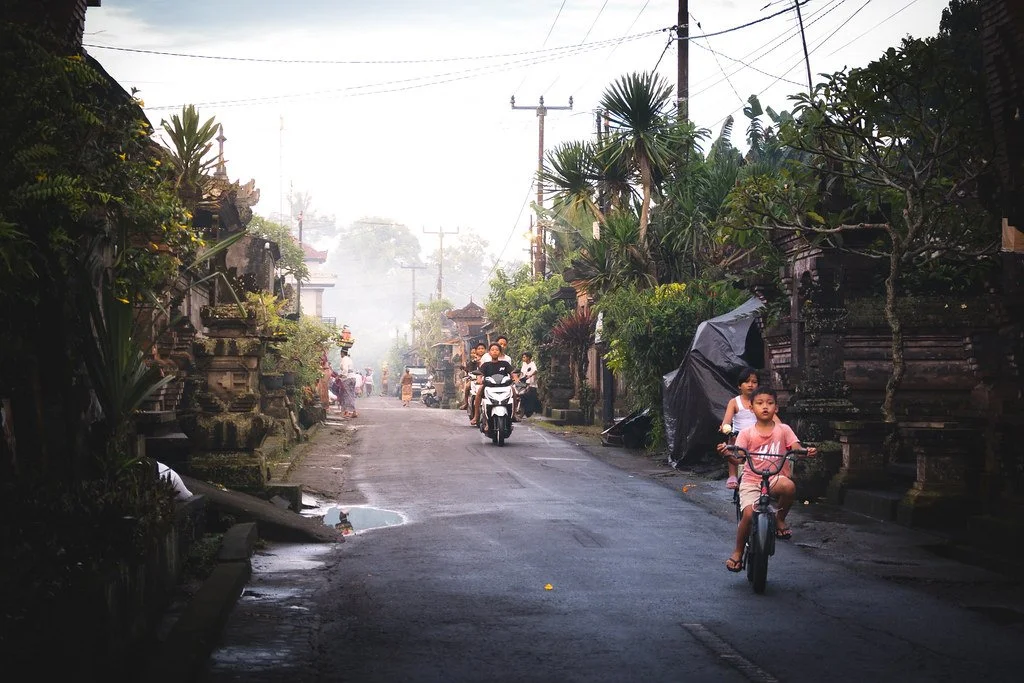
Across Java, Indonesia's most populous island, millions of families begin each day much the same way. Before the streets fill with motorcycles and the afternoon heat settles in, parents are already planning how to stretch another day's earnings into another week's worth of necessities.
For many, the challenge is not unemployment.
It is uncertainty.
Unlike salaried workers who know what their paycheck will look like at the end of the month, many Indonesians earn their income through informal work—driving passengers, selling goods at local markets, farming family land, or taking seasonal jobs that fluctuate with demand. Income can rise during busy periods and disappear just as quickly when business slows.
This unpredictability means that even small financial setbacks can ripple through an entire household.
A week without enough customers.
Higher fuel prices.
Unexpected medical expenses.
A motorcycle repair.
Each decision forces another.
The Hidden Cost of Education
Indonesia has made remarkable progress in expanding access to education, with public schools offering subsidized tuition for many families. Yet education is rarely free in practice.
Parents are often responsible for purchasing uniforms, textbooks, transportation, school supplies, extracurricular fees, and other expenses that accumulate throughout the year. For households living on variable incomes, these costs can quickly become difficult to manage.
The result is a reality familiar to parents around the world.
Education isn't only about opportunity.
It's also about affordability.
A single unexpected expense can force families to postpone payments, borrow from relatives, or delay purchases they had carefully planned.
These decisions rarely happen because education isn't valued.
They happen because necessities compete with one another.
More Than a Number
Economic statistics help explain part of the picture.
Average household incomes vary widely across Indonesia depending on the region, while inflation and rising transportation costs continue to place pressure on everyday budgets. Families working in agriculture, transportation, tourism, and other informal sectors often feel these changes first because their income can fluctuate from month to month.
Yet numbers alone cannot explain what resilience looks like.
Resilience is a father repairing his motorcycle because without it he cannot reach work.
It is a mother carefully budgeting for school uniforms months before classes begin.
It is grandparents helping care for children while parents search for seasonal employment.
These are not extraordinary acts.
They are ordinary ones repeated every day.
Looking Beyond the Destination
Travel has a way of introducing us to places.
If we're paying attention, it also introduces us to people.
The driver navigating unfamiliar roads.
The market vendor greeting every customer with the same smile.
The farmer tending rice fields long before visitors arrive with cameras.
These individuals rarely appear in guidebooks, yet they shape our experience of a destination as much as any famous landmark.
Understanding their stories asks something different of us.
Not guilt.
Not pity.
Simply curiosity.
Because behind every unforgettable journey is someone quietly working to make tomorrow possible—for themselves, for their families, and for the strangers fortunate enough to pass through.
As travelers, we often measure a destination by what it gives us.
Perhaps the better question is what we learn when we take the time to understand the lives already unfolding there.
Photography by Adriana Bugarin